
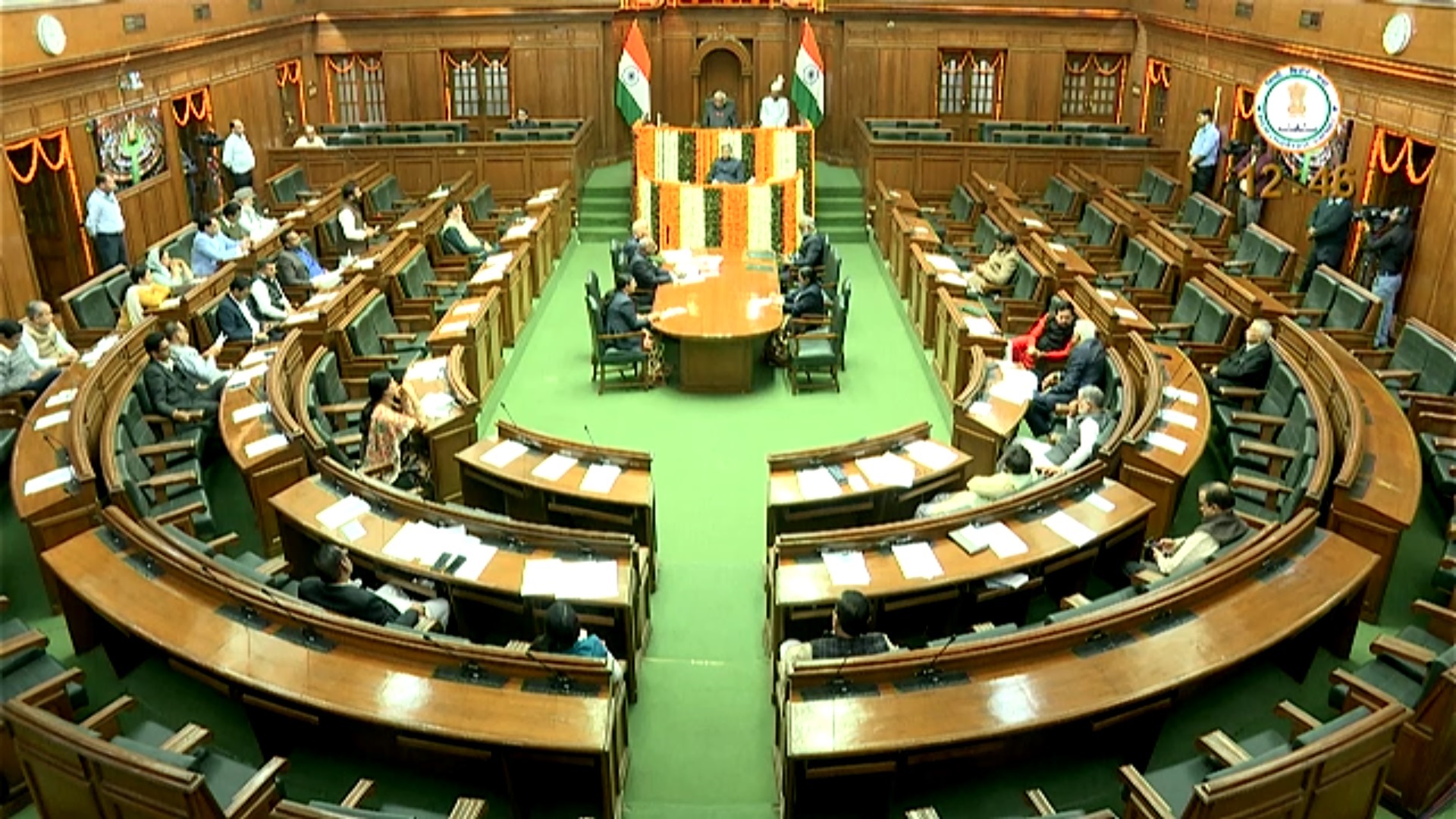
The Delhi Legislative Assembly stands as one of the most significant landmarks in India’s democratic evolution. Few buildings in the country can claim a legacy as deep and consequential as this one. More than a century ago, in 1911, Lord Hardinge, the then Viceroy of India, made a decision that would forever change the political geography of the subcontinent. He shifted the Imperial Capital from Calcutta to Delhi, envisioning a new administrative centre for British India. As part of this monumental transition, the Old Secretariat — now home to the Delhi Legislative Assembly — was constructed between 1912 and 1915. Designed by British architect E. Montague Thomas, the building was created to house the Imperial Legislative Council and several key offices of the colonial administration. Between 1912 and 1926, this very chamber served as the seat of the Central Legislative Assembly, hosting the legislative proceedings of the British Indian government before they were moved to the newly built Parliament House.
It was within these walls that India’s earliest experiments in lawmaking took shape, long before the country envisioned self-rule. Over time, the Old Secretariat ceased to be merely a colonial administrative space and evolved into a crucible of political consciousness. The hall that once echoed with the voices of imperial authority became a stage for the nation’s rising aspirations. Here, nationalist stalwarts such as Lala Lajpat Rai, Madan Mohan Malaviya and Gopal Krishna Gokhale questioned the moral legitimacy of British rule and spoke fearlessly of India’s right to freedom. Opposition to the Rowlatt Act gained early traction in this very chamber, and it became a rallying point for the Non-Cooperation Movement and the broader political awakening that was sweeping across the nation in the early 20th century.
A defining moment in the building’s legacy came in 1925, when Veer Vithalbhai Patel was elected as the first Indian Speaker of the Legislative Assembly. Patel’s leadership redefined the parliamentary ethos of the country. His insistence on fairness, order and respect for every member of the House set the tone for how India’s legislatures would function in the years to come. His tenure also established the independence and dignity of the Speaker’s office — a legacy that continues to guide parliamentary functioning even today, a hundred years later.
After India’s independence, the Old Secretariat entered a new chapter. In 1952, Delhi was granted its own Legislative Assembly as a Part-C state, giving the capital a measure of self-governance. However, this Assembly was later dissolved in 1956 following the reorganisation of states. A decade later, in 1966, the Delhi Metropolitan Council was formed, and its meetings, too, were held in the same historic hall. For years, the building continued to serve as a seat of deliberation, even as it quietly witnessed India’s post-independence political transformation. Yet despite its immense historical significance, the Delhi Assembly building did not receive the national recognition it deserved. Its contribution to India’s democratic journey remained largely confined to history books, overlooked amid the grand narratives of the Parliament House and other national institutions.
That has begun to change under the stewardship of the current Speaker, Vijender Gupta. Determined to restore the Assembly’s rightful place in India’s democratic memory, Gupta has led efforts to revive and celebrate its heritage. Under his vision, the Delhi Legislative Assembly has now been declared a National Heritage Monument, officially recognising its unparalleled role in shaping India’s parliamentary history. His initiative has not only brought historical attention back to the building but has also transformed it into a vibrant symbol of democratic continuity — linking the ideals of the past with the aspirations of the present.
The Delhi Assembly is now preparing to host one of the most important democratic gatherings of modern times — the All India Speakers’ Conference, scheduled for 24–25 August 2025. This year’s conference holds special significance as it marks the centenary of Veer Vithalbhai Patel’s election as the first Speaker of an Indian legislature. The event will bring together Lok Sabha Speaker Om Birla, Union Home Minister Amit Shah, several Union Ministers, state legislative Speakers and senior leaders from across the country. For the first time in decades, India’s legislative leadership will converge within the same hall that once witnessed the nation’s earliest parliamentary debates.
More than a ceremonial event, the conference represents a symbolic return to the birthplace of India’s democratic tradition. A hundred years after Vithalbhai Patel’s election, the same chamber that defined the principles of fairness, debate and democratic governance will once again resonate with deliberations shaping India’s future. In many ways, history will come full circle — where the foundations of India’s legislative system were once laid, the nation’s leaders will gather to reaffirm their faith in those very ideals.
As the Delhi Assembly reclaims its place in India’s democratic imagination, it stands not merely as a monument of the past but as a living institution that continues to define the spirit of governance and representation. With renewed recognition and purpose, the building now serves as a reminder that India’s democracy did not begin in 1947 — it began here, in these echoing chambers, where voices of dissent, hope and nationhood first rose against the might of empire. Today, as it prepares to host the country’s Speakers once again, the Delhi Assembly stands as both witness and participant in the ongoing story of India’s democracy — a story that began over a century ago and still unfolds within its historic walls.
